 Sandridgebury Lane, St Albans, Hertfordshire, AL3 6DB


Psychology
Curriculum Intent and Overview
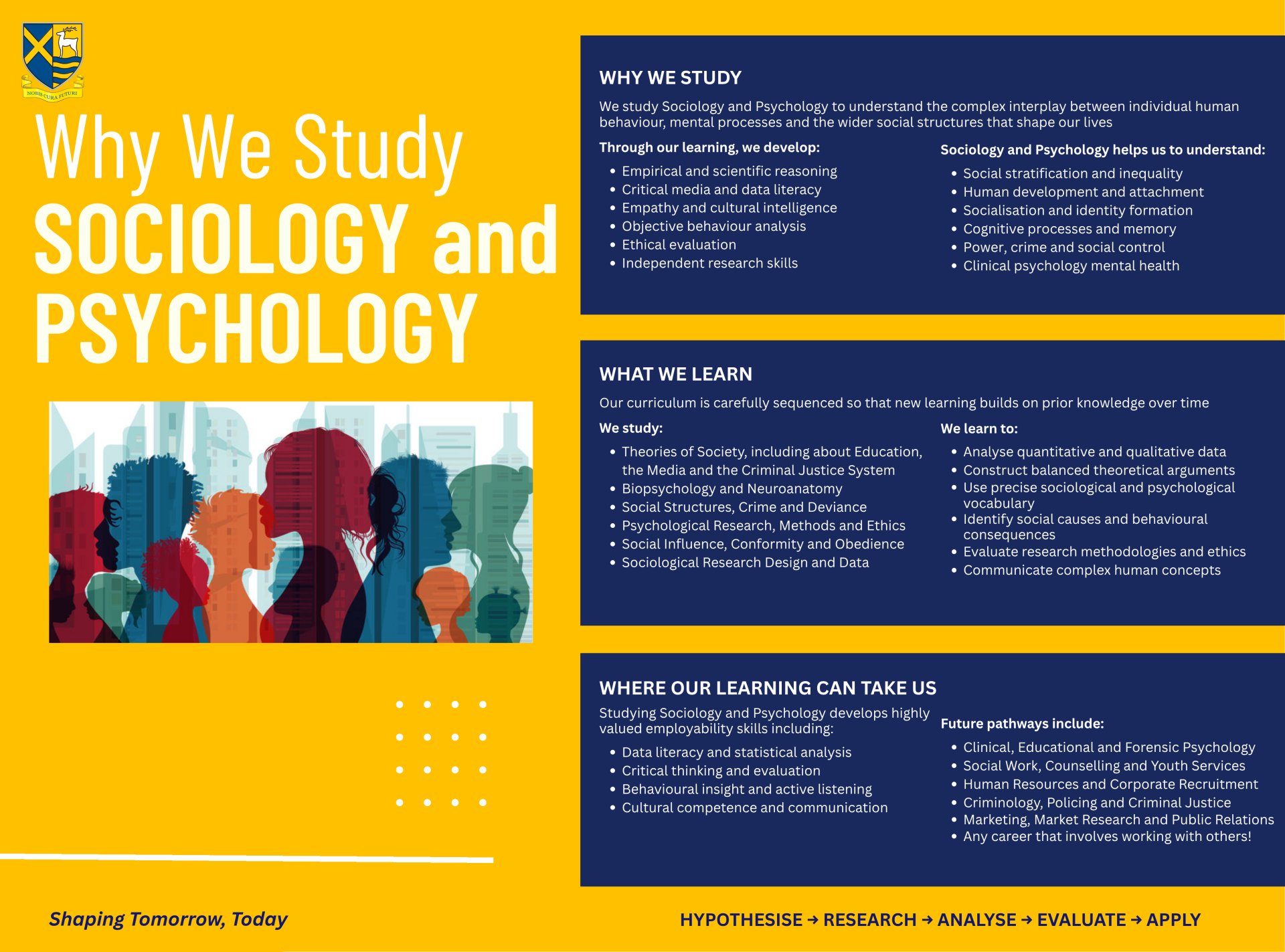
Psychology lies at the intersection of applied and theoretical science and its relevance to daily life plays a significant role in its delivery. At its core the discipline helps students understand how the body and mind work together to influence behaviour and the variety of topics presented aim to introduce students to a range of psychological perspectives all with key scientific principles, approaches and issues and debates fully embedded. Students also build a wide range of transferable skills that aid their individual and career development: critical thinking, reasoning, research, communication, analysis and problem solving, even mastering the art of conflict resolution.
The Department
Curriculum Leader: Miss K Hare
A Level
Exam Board: AQA
Specification Number: 7182
What is Psychology?
Psychology is an interesting, stimulating and challenging subject that complements a wide range of traditional subjects. Psychology is the scientific study of the mind and behaviour, and its subject matter is primarily people, their experiences and their behaviour although it does include some study of non-human animals. Its immediate goal is to understand humanity by both discovering general principles and exploring specific cases, and its ultimate aim is to benefit society.
Learning methods
Learning methods include discussions, debates, videos, individual and group presentations, classroom exercises and activities. Students are expected to make an active contribution to whatever method is being used. There is a very wide syllabus to cover and students are required to carry out substantial research on their own. Students must be prepared to spend time reading around the subject or researching specific topics – in this way the vital skills of independent learning are acquired and developed.
Expectations of students
As Psychology is a new subject to all students, students need to be aware of the need for strong analytical and evaluative skills. They must be persuasive writers as there is rarely a single, correct answer to any question. The aim is to use psychological knowledge and evidence in order to support an argument or opinion. Fluency (both written and verbal) is essential as is a secure understanding of certain scientific principles particularly in human biology. A facility in mathematics and the ability to interpret numerical data is also beneficial.
Why study Psychology at St Albans Girls' School?
Psychology is taught by specialist teachers with extensive experience, a focus on exam technique and a clear enthusiasm for the subject. The department makes available a wide range of resources including a variety of textbooks to help promote independent learning and effectively uses the Google Classroom providing links to websites, enabling students to research and to participate in discussion forums.
Career paths
A first degree in psychology can lead to a further degree in a wide range of related fields (e.g. clinical, educational, occupational psychology etc.) However, it is also highly regarded and a useful entry point for virtually any career that involves interacting with people. N.B. Psychology is a science and as such continues to be regarded as one of the sciences for entry to university medical schools. See the British Psychological Society (BPS) website for further career ideas: www.bps.org.uk/what-psychology
What is the course content?
Paper 1: Introductory Topics in Psychology
- Social Influence
- Memory
- Attachment
- Clinical psychology and mental health
Paper 2: Psychology in Context
- Approaches in psychology
- Biopsychology
- Research methods
Paper 3: Issues and Options in Psychology
- Issues and debates in psychology
- Option 1: Gender
- Option 2: Schizophrenia
- Option 3: Forensic psychology
How will students be assessed?
The course is linear, so students will sit 3 externally set and marked examinations at the end of Year 13. Each written examination is 2 hours duration, 96 marks in total and 33.3% of the qualification.
Assessments in psychology employ a variety of question types including multiple choice, short answer and extended writing/essays, which target the skills of knowledge and understanding, application and evaluation. Students’ understanding of research methods, gained through classroom experience of practical Psychology, is assessed using scenario-based questions and research methods questions embedded within topics.
Overall, at least 10% of the marks in assessments for Psychology will require the use of mathematical skills. These skills will be applied in the context of A-level Psychology and will be at least the standard of higher tier GCSE mathematics. At least 25–30% of the overall assessment will assess skills, knowledge and understanding in relation to research methods.
What texts are recommended?
The Complete Companions for AQA Psychology A Level: Year 1 and AS Student Book, 6th Edition. Oxford University Press - by Mike Carwell & Adelaide McLaughlin. (ISBN: 978-1382071840)
The Complete Companions for AQA Psychology A Level: Year 2 Student Book, 6th Edition. Oxford University Press - by Mike Carwell & Adelaide McLaughlin. (ISBN: 978-1382071871)
AQA Psychology for A Level : Year 1 and AS Third edition. Hachette Learning - by Cara Flanagan et al. (ISBN: 978103601197)
AQA Psychology for A Level: Year 2 Third edition. Hachette Learning - by Cara Flanagan et al. (ISBN: 9781036011987)
There are also a range of older textbooks affiliated to the previous AQA A specification and revision guides which will also be of use and copies are held in the departmental library.
What websites are recommended?
AQA Website: https://www.aqa.org.uk/subjects/psychology
YouTube : Tutor2U: https://www.tutor2u.net/psychology
JSTOR: https://www.jstor.org/
Seneca Learning: https://www.senecalearning.com/
Physics and Maths Tutor: https://www.physicsandmathstutor.com/
Psychboost: https://www.psychboost.com/
What equipment is needed?
A calculator, ruler, pen and pencil are essential at all times as well as A4 file paper and a robust lever arch folder for each topic with dividers and plastic wallets.